Why Self-Checkout Works in Some Stores and Fails in Others
Self-checkout is often discussed as if it is either the future of retail or a failed experiment. Neither view is especially useful for operators.
The better question is more practical: what kind of checkout work is the customer being asked to do?
Self-checkout works well when transactions are simple, baskets are small, exceptions are rare, and customers already know what they are buying. It struggles when the sale requires service, judgment, age verification, account context, returns, item lookup, inventory questions, coupons, split tenders, or a conversation with someone who understands the store.
That distinction matters because checkout is not just a payment endpoint. It is where store execution, customer experience, inventory accuracy, loss prevention, associate workflow, and payment logic all meet.
For retailers with physical storefronts, this is the bigger issue: if the store removes too much of the human layer, it starts giving up one of the main reasons the store exists.
Self-checkout is best for simple baskets
There are environments where self-checkout makes sense. A customer with five familiar items, no questions, and a preferred card or wallet may move through faster without waiting for a cashier. In high-volume stores, self-checkout can help absorb traffic during peaks and give customers more choice.
That is why some retailers are not removing self-checkout entirely. They are narrowing where and how it is used.
Target, for example, moved toward “express self-checkout” with a 10-item limit at most stores in 2024. Grocery Dive reported that Target’s pilot found the limited-item version of self-checkout was faster, while store leaders were also given more flexibility to adjust staffed lanes and self-checkout availability through the day.
That is a useful operational signal. The question is not “self-checkout or no self-checkout?” It is “which transactions belong in which lane?”
Small baskets are easier for customers to scan accurately. They create fewer bagging issues and fewer complicated exceptions. They also reduce the awkward moment where a shopper with a full cart blocks a self-checkout station for a long transaction that would have been easier with an associate.
Exceptions change the math
Self-checkout looks efficient when the transaction follows the happy path. The trouble is that retail has a lot of unhappy paths.
An item does not scan. A barcode is damaged. A product needs a price check. A loyalty offer does not apply. A customer wants to split payment across a gift card, credit card, and cash. An item requires age verification. A shopper changes their mind mid-transaction. A return turns into an exchange. Inventory says the item exists, but the shelf says otherwise.
In those moments, the “self” in self-checkout disappears. An associate has to step in, often while monitoring several stations at once. If the associate does not have the right tools, permissions, visibility, or training, the customer experience can get worse quickly.
This is where many retailers underestimate checkout complexity. The scan-and-pay portion of a transaction is only one piece of the work. The hard part is handling exceptions cleanly without creating delays, confusion, shrink risk, or bad data.
The store has to be more than a local payment terminal
This is where the self-checkout conversation gets more interesting for retailers with real storefronts.
If a customer wants a fully self-directed, low-service transaction, ecommerce already does that well. A physical store has different costs and different advantages. It has rent, labor, fixtures, inventory exposure, shrink risk, and operating complexity. In exchange, it should offer something ecommerce cannot fully replace.
That something is often the associate.
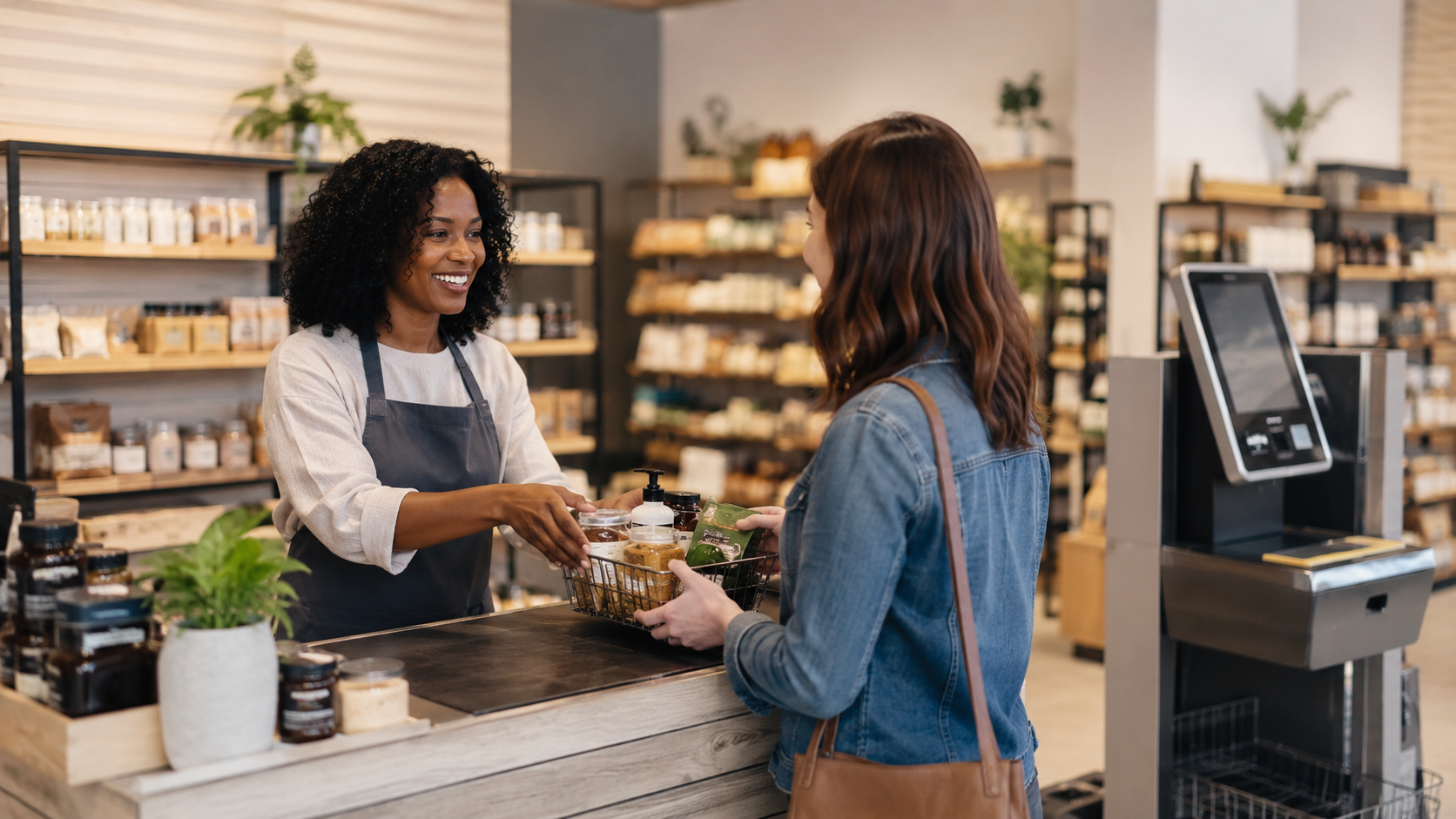
Associates help customers make decisions. They answer questions. They solve problems. They notice confusion. They handle exceptions. They connect the transaction to the customer’s actual need. In specialty retail, B2B counter sales, complex product categories, and service-led environments, that human layer is not a nice-to-have. It is part of the store’s value proposition.
So if a retailer invests in storefronts but pushes too much of the customer journey into unattended self-service, it should ask a hard question: what is the store adding that the customer could not get from an online cart?
That does not mean every transaction needs a full-service checkout conversation. It does mean the checkout strategy should reinforce why the store exists. For many merchants, the answer is not fewer humans. It is better-equipped humans.
Assisted checkout is not old-fashioned
Assisted checkout can sound like a step backward if the only goal is automation. But in complex retail environments, a strong associate-led checkout can be faster and better than pushing customers through self-service.
That is especially true in specialty retail, B2B counter sales, stores with high-consideration products, or environments where customers often need advice. In those settings, the associate is not simply scanning items. They may be confirming fit, checking availability, applying customer-specific pricing, managing account terms, explaining returns, coordinating pickup, or helping the customer complete a purchase that started online.
The associate also protects operational quality. A trained cashier can catch item mismatches, apply the right tender rules, attach the right customer account, explain a policy, and keep the transaction record clean. That matters downstream for inventory, reporting, replenishment, returns, accounting, and customer service.
The better use of technology is not always to remove the associate from checkout. Often, it is to give the associate better POS tools, better customer context, better inventory visibility, and cleaner workflows so they can complete the sale with less friction.
Shrink is part of the story, but not the whole story
Retailers are paying close attention to shrink and front-end controls. NRF’s 2025 retail theft and violence research describes theft and violence as growing in sophistication and complexity, based on a survey of senior loss prevention and security executives.
Self-checkout often enters that conversation because it can create more opportunities for missed scans, mistakes, or intentional non-scans. But retailers should be careful not to reduce the entire debate to theft. Shrink is one factor. Customer experience, basket size, staffing, store format, product mix, associate visibility, and checkout design all matter too.
Dollar General’s self-checkout pullback is a useful example of how operational context can change the decision. Retail Dive reported in 2025 that, after removing most self-checkout, Dollar General pointed to lower shrink and higher inventory markup as factors supporting gross margin improvement. Grocery Dive had previously reported that Dollar General converted self-checkout registers to assisted checkout options in thousands of stores and removed self-checkout from some high-shrink locations.
That does not mean every retailer should follow the same path. It means self-checkout has to be measured against the realities of the store.
The right checkout model depends on the operating environment
A retailer deciding how much self-checkout to use should look beyond lane count and labor assumptions. The better starting point is transaction behavior.
Useful questions include:
- How many transactions are truly simple baskets?
- Which categories create the most interventions?
- How often do associates override, void, price-check, or assist?
- Which tenders create friction?
- How often do returns or exchanges happen near checkout?
- Are customers buying familiar commodity items or products that require advice?
- Does the store have enough associates to monitor self-checkout without abandoning service elsewhere?
- Are transaction records staying accurate enough for inventory and reporting?
The answers may vary by store, region, season, and even time of day. A retailer might use self-checkout heavily during quick-trip periods, limit it to express baskets, close it during low-staffed windows, or keep it out of stores where customer assistance is central to the sale.
POS should support associates, not work around them
Whether a retailer chooses self-checkout, assisted checkout, mobile checkout, kiosks, or a hybrid model, the POS system has to support how the store actually works.
That means more than accepting payments. A modern POS environment needs to help associates manage exceptions, understand customer and inventory context, apply the right pricing and tender rules, handle returns and exchanges, and keep data aligned with the rest of the business.
When checkout tools are disconnected from operational reality, every exception becomes harder. Associates rely on workarounds. Managers lose visibility. Inventory gets less trustworthy. Customers wait longer. The retailer may think it has simplified checkout when it has really moved complexity somewhere else.
Self-checkout can be a good fit. Assisted checkout can be a good fit. The mistake is assuming either one is automatically better.
For merchants with storefronts, the stronger question is this: does the checkout model make the store more worth visiting?
In simple, low-exception environments, self-checkout can help customers move quickly. But in service-led retail, specialty retail, account-based selling, and complex checkout environments, the associate is often the advantage. The right POS should amplify that advantage, not erase it.
The strongest checkout model is not necessarily the one with the fewest people. It is the one where associates have the tools, data, and workflows to make the store work better.
Explore how SuitePOS helps retailers simplify complex checkout workflows.